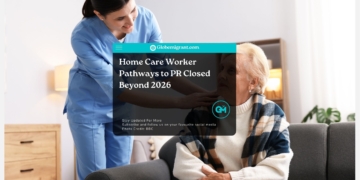




Home care worker pathways to permanent residency in Canada will stop accepting new applications in 2026, following the publication of newly issued Ministerial Instructions in the Canada Gazette. Immigration, Refugees and Citizenship Canada (IRCC) confirmed that no new applications will be accepted under the current home care worker pilots from March 31, 2026, through March 30, 2030.
This announcement reverses earlier expectations that the pilots would reopen in spring 2026 and signals a significant policy shift for foreign nationals seeking permanent residence through Canada’s caregiving sector.
Overview Of The Home Care Worker Immigration Pilots
The Home Care Worker Immigration Pilot and the Child Care and Home Care Worker Immigration Pilot officially launched on March 31, 2025. These programs were designed to provide direct permanent residence pathways for foreign nationals with qualifying job offers in home care or child care occupations.
IRCC initially set the application window for both pilots to run from March 31, 2025, to March 30, 2026. However, both programs reached their annual intake caps within hours of opening, reflecting exceptionally high demand and limited quota availability.
These pilots were structured as capped, first-come, first-served programs, meaning eligible applicants had to submit complete applications immediately upon intake opening to secure a spot.
Eligibility Requirements And Intake Structure
- To qualify under either pilot, applicants were required to meet several baseline criteria. These included a high school diploma or equivalent, proof of English or French language proficiency at the required level, and either relevant work experience or formal training in caregiving occupations.
- Applicants also needed a valid job offer in Canada in an eligible home care or child care role. IRCC imposed annual caps on the number of permanent residence visas issued under each pilot, which directly contributed to the rapid closure of intake windows.
- The capped intake model has been widely criticised by immigration observers for limiting access to otherwise qualified workers, particularly in a sector facing chronic labour shortages.
Program Duration And Policy Implications
- Under federal immigration policy, pilot programs may operate for up to 5 years. At the end of that period, successful pilots may be transitioned into permanent immigration programs, modified, or discontinued entirely.
- With IRCC confirming that no new applications will be accepted between 2026 and 2030, it remains unclear whether the home care worker pilots will evolve into permanent programs or be replaced by alternative pathways. The pause effectively leaves prospective caregivers without a dedicated federal permanent residence stream during that period.
- This development may increase pressure on provincial nominee programs and employer-driven pathways to absorb demand from the caregiving workforce.
Impact On Foreign Caregivers And Employers
- The closure of new intakes under these pilots creates uncertainty for foreign caregivers planning long-term settlement in Canada. Many workers had anticipated a reopening in 2026 and structured employment plans around that expectation.
- Canadian employers in the home care and child care sectors may also face increased recruitment challenges, as permanent residence incentives have been a key factor in attracting and retaining foreign workers.
- Without a clear replacement pathway, stakeholders are expected to closely monitor IRCC policy updates and future immigration level announcements.
Key Takeaways
- The home care worker immigration pilots will not accept new applications after March 30, 2026.
- Both pilots reached their intake caps within hours of launch in 2025.
- The programs were designed as capped, first-come, first-served pathways to permanent residence.
- No new applications will be accepted between 2026 and 2030 under the current instructions.
- The future of these pathways remains uncertain pending further federal policy decisions.
The decision to halt new applications under Canada’s home care worker permanent residence pilots marks a major shift in caregiver immigration policy. While the programs demonstrated strong demand, their capped structure and temporary status have left many prospective applicants without a clear long-term pathway.
As Canada continues to balance labour shortages with immigration planning, the fate of caregiver-focused permanent residence programs will remain a critical issue for workers, employers, and policymakers alike.
Was this helpful?
Thanks for your feedback!