International Experience Canada 2026 (IEC) has officially reopened, allowing eligible foreign youth to submit new candidate profiles for the upcoming season. The program enables young citizens from participating countries to live and work in Canada for up to two years under an IEC work permit, depending on nationality and category. Immigration, Refugees and Citizenship Canada (IRCC) will issue invitations throughout the 2026 season to candidates across multiple IEC pools.Candidates who created a profile in 2025 but were not invited must submit a fresh profile to be considered for 2026. IEC profiles do not roll over between seasons.
Who Qualifies For International Experience Canada 2026
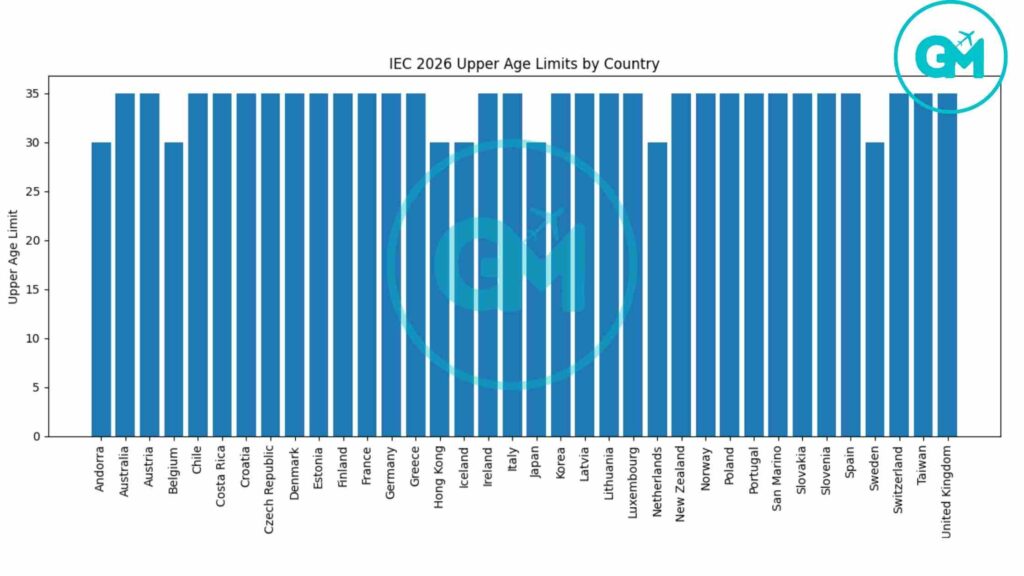
IEC is open to citizens of countries that have a bilateral Youth Mobility Agreement with Canada. Eligibility depends on nationality, age, and participation limits. Applicants must also meet standard entry requirements to Canada.Eligible nationalities, age limits, and participation caps are outlined below.Infographic showing Who Qualifies For International Experience Canada 2026Each country operates under its own agreement with Canada, which may restrict how many times a candidate can apply or which categories are available. These country-specific rules are set by IRCC and reviewed annually.
General Eligibility Requirements All IEC Candidates Must Meet
In addition to nationality and age requirements, IEC candidates must satisfy the following conditions at the time of application:
Be at least 18 years old.
Hold a valid passport for the full duration of the stay.
Carry private health insurance covering the entire period in Canada.
Show proof of at least CAD $2,500 in available funds.
Have a return ticket or sufficient funds to purchase one.
Meet standard Canadian admissibility rules.
Dependents cannot accompany IEC participants. Some candidates may also be required to submit proof of a job offer, depending on the IEC category selected. Official eligibility rules are published by IRCC.
IEC Work Permit Categories Available in 2026
IEC offers three distinct work permit categories, each serving different objectives and eligibility profiles. All IEC permits are exempt from the Labour Market Impact Assessment requirement.
1. Working Holiday
This category issues an open work permit, allowing participants to work for almost any employer in Canada. No job offer is required at the time of application. Due to high demand, this category is typically the most competitive.
2. Young Professionals
The Young Professionals category issues a closed work permit tied to one employer. A qualifying job offer is mandatory, and the role must fall under TEER 0, 1, 2, or 3 and contribute to professional development. Self-employment is not permitted. This category is generally less competitive than the Working Holiday.
3. International Co-op (Internship)
This category is designed for students enrolled in post-secondary programs outside Canada. The internship is required to complete the academic program. The work permit is employer-specific and typically the least competitive IEC stream.
Working Holiday
Open
No
Very high
Young Professionals
Closed
Yes
Moderate
International Co-op
Closed
Yes
Lower
How To Apply For An IEC Work Permit
The IEC process begins with creating an online candidate profile through an IRCC secure account. Applicants may enter one or more IEC pools if eligible.Once a profile is submitted, IRCC conducts regular invitation rounds. If selected, candidates must:
Accept the Invitation to Apply within 10 days.
Submit a complete work permit application within 20 days.
Upload documents listed in the personalized checklist.
Pay applicable fees
Fees include:
CAD $184.75 work permit processing fee for all applicants
CAD $100 open work permit fee for Working Holiday participants
CAD $230 employer compliance fee paid by employers for closed permits
CAD $85 biometrics fee if biometrics are required
Biometrics instructions are issued after application submission, with a 30-day deadline. Approved applicants receive a Port of Entry letter valid for one year. This letter does not guarantee entry, as final approval is granted by border officers.
How IEC Selection Works And Your Chances Of Receiving An Invitation
IEC selections operate on a randomized lottery system. Each country has annual quotas by category, and IRCC conducts rounds weekly or bi-weekly until quotas are filled or the season ends.IRCC publishes estimated invitation likelihoods on its IEC portal, categorised as:
Excellent (80 to 90 percent)
Very good (60 to 70 percent)
Fair (40 to 50 percent)
Low (20 to 39 percent)
Very low (1 to 19 percent)
Selection chances fluctuate based on pool size, quota availability, and the number of candidates who accept or decline invitations. The Young Professionals category is often prioritised, increasing invitation odds for candidates with qualifying job offers. IRCC may also conduct additional rounds after the final published draw if spots remain unfilled.
Key Takeaways
IEC 2026 pools are officially open, and new profiles are required for all candidates
Citizens of 36 countries aged 18 to 35 may qualify.
Three work permit categories are available, each with different competitiveness levels.
Invitations are issued through random draws until country quotas are filled.
Early profile submission improves exposure across multiple invitation rounds.