



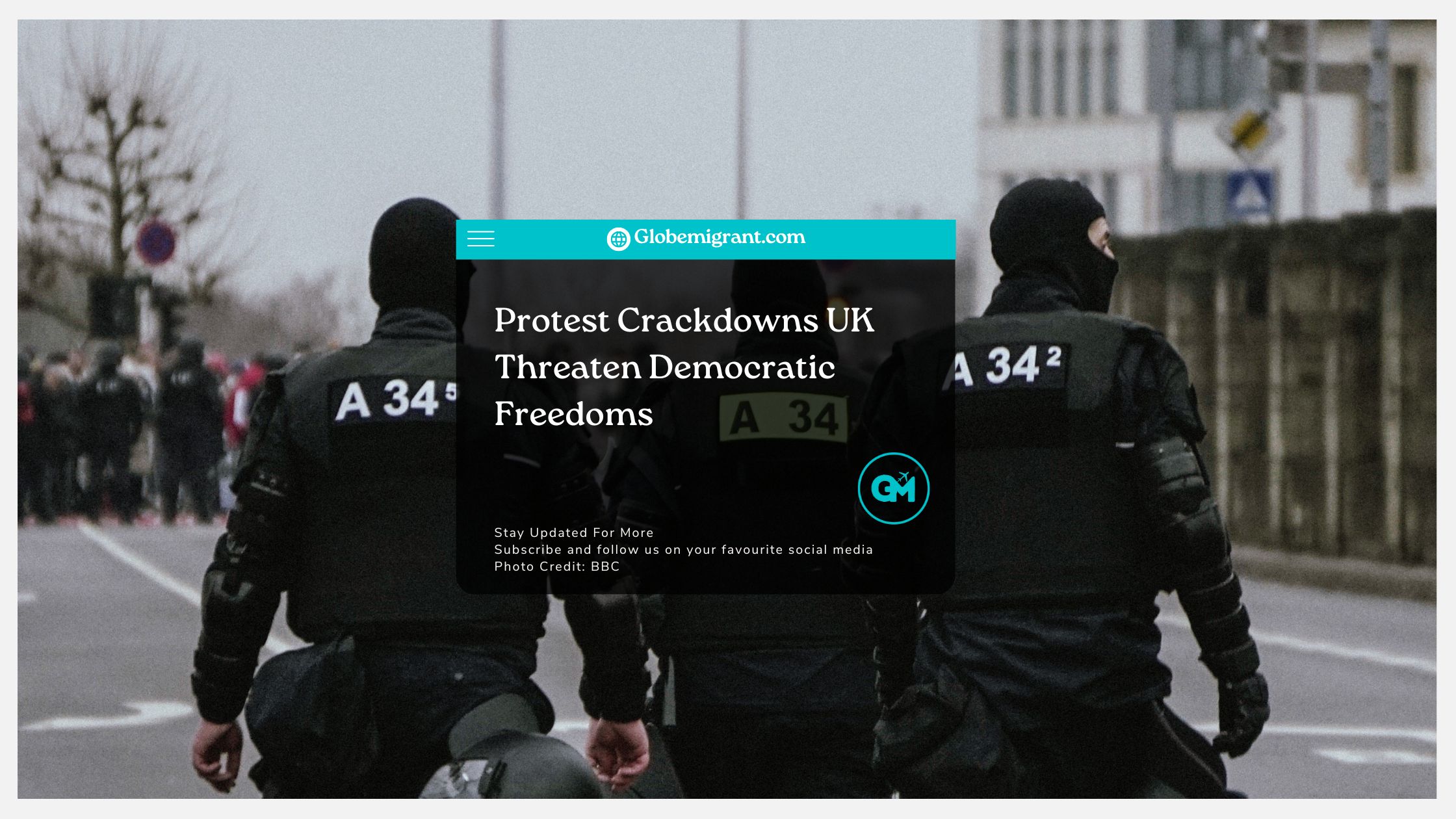
Escalating protest crackdowns in the UK are raising serious alarms about democratic backsliding and violations of international human rights obligations. Recent developments show that restrictions on peaceful protest have not only continued but expanded under the current Labour administration. Rather than reversing controversial policies inherited from previous governments, new measures appear designed to entrench and normalize aggressive controls on civil dissent.
A detailed Human Rights Watch report released on January 8, 2026, paints a troubling picture of how protest rights are being steadily eroded across the country. Titled Silencing the Streets: The Right to Protest Under Attack in the UK, the 47-page report documents how peaceful demonstrations are increasingly treated as criminal activity, placing the UK on a worrying trajectory that mirrors trends seen in democracies under strain.
Human Rights Watch Findings On Protest Restrictions
Human Rights Watch highlights a clear shift in how UK authorities approach protest. Peaceful acts of dissent are now frequently framed as public order threats or even security risks. Existing laws are being interpreted broadly, while new legislation threatens to further expand police powers.
Crime and Policing Bill 2025 stands out as a major flashpoint. Set for debate in the House of Lords in January 2026, the bill would significantly expand police powers, enabling pre-emptive arrests and imposing harsher penalties for nonviolent protest. Concerns are amplified by the fact that this bill builds on already restrictive frameworks introduced by the previous Conservative government.
The Police, Crime, Sentencing and Courts Act 2022 and the Public Order Act 2023 laid much of the groundwork for current enforcement practices. Instead of reassessing or rolling back these laws, Labour has signaled an intention to reinforce and extend them.
According to Lydia Gall, senior researcher at Human Rights Watch, protest control tactics in the UK increasingly resemble those used in countries experiencing democratic decline. Vague legal definitions and wide discretionary powers give law enforcement significant latitude to restrict protests, often with minimal oversight or accountability.
Legal ambiguity plays a central role in this shift. Broad terms such as “serious disruption” allow authorities to intervene early and aggressively, even when protests are nonviolent. Such provisions make it easier to suppress demonstrations before they gain visibility or momentum.
Cases That Illustrate Overreach
Trudi Warner’s arrest illustrates how far enforcement has stretched. A retired social worker, Warner was detained for holding a sign outside a courthouse that informed jurors of their rights. High Court judges later dismissed the charges as baseless, yet the Labour government initially pursued an appeal, reinforcing fears of institutional hostility toward protest.
Another stark example emerged in July 2024, when five Just Stop Oil activists received prison sentences of up to five years for participating in a Zoom call to organize a peaceful protest. The High Court’s intervention in March 2025 acknowledged that the sentences were excessive, though only marginal reductions were granted. The severity of the punishment sent a chilling message to activists across the country.
What the Crime And Policing Bill 2025 Could Change
Provisions within the proposed Crime and Policing Bill 2025 threaten to intensify existing restrictions. Measures include expanded authority to ban face coverings at protests and new limits on demonstrations near places of worship.
Poorly defined criteria increase the risk of discriminatory enforcement, particularly against marginalized communities.
Undocumented individuals, asylum seekers, and minority groups face heightened risks when exercising protest rights under such laws. Fear of surveillance, arrest, or deportation may effectively silence voices already excluded from mainstream political participation.
Domestic and international legal frameworks impose clear obligations on the UK to protect freedom of expression and peaceful assembly. The Human Rights Act 1998 and the International Covenant on Civil and Political Rights both enshrine these rights. Current policies, however, appear increasingly incompatible with these commitments.
Human Rights Watch argues that meaningful reform must include repealing or amending the Police, Crime, Sentencing and Courts Act 2022 and the Public Order Act 2023. Without such changes, further erosion of civic space remains likely.
Calls have also been made for an independent public inquiry into protest policing. Such an inquiry could assess whether enforcement practices align with international human rights standards and restore public trust.
The ability to protest peacefully is a cornerstone of a democratic society. When governments suppress dissent rather than engage with it, accountability weakens and power concentrates. Patterns emerging in the UK suggest a narrowing of acceptable political expression, with long-term implications for civic participation.
Human Rights Watch warns that continued crackdowns risk normalizing repression and discouraging lawful protest altogether. Democratic resilience depends on protecting dissent, not criminalizing it.
Key Takeaways
- Protest crackdowns in the UK have intensified under the Labour administration rather than eased.
- Human Rights Watch documents the increasing use of criminal and terrorism laws against peaceful protesters.
- The Crime and Policing Bill 2025 would further expand police powers and restrict demonstrations.
- Existing laws from 2022 and 2023 already enable broad and vague enforcement.
- High-profile cases reveal disproportionate penalties for nonviolent protest activity.
- Current policies conflict with UK obligations under domestic and international human rights law
- Urgent legal reform and independent oversight are needed to safeguard democratic freedoms.
Was this helpful?
Thanks for your feedback!