


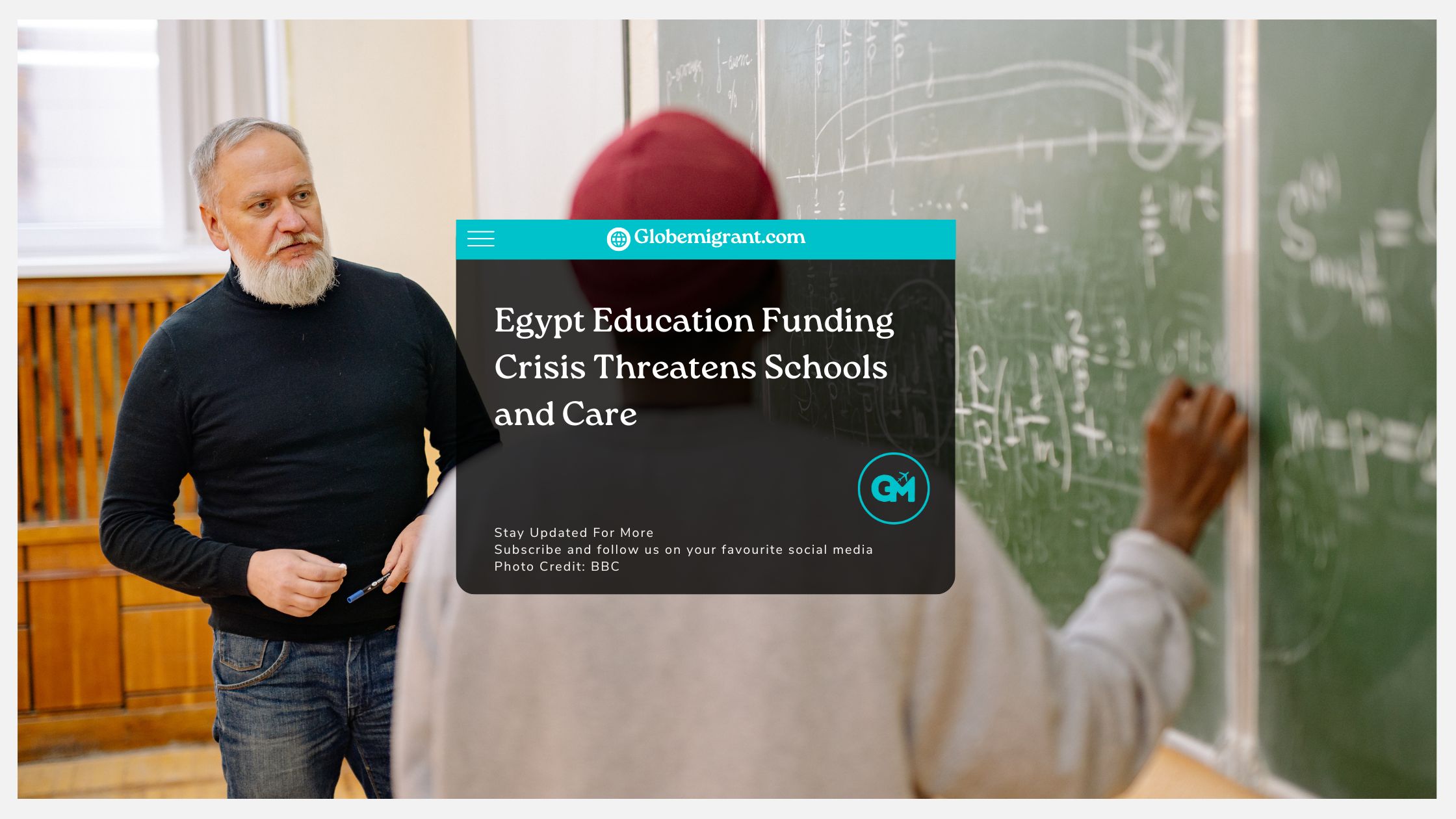
Egypt education funding has reached a critical low, placing millions of children and families at risk as schools and health facilities struggle to operate. Findings from Human Rights Watch show that government spending on education and health care continues to fall far below constitutional requirements and international standards, undermining basic social and economic rights.
Budgetary neglect has led to overcrowded classrooms, teacher shortages, underpaid medical staff, and rising out-of-pocket costs that many families cannot afford.
Education Budget Falls Below Constitutional Limits
Education spending in Egypt has steadily declined over the past five years, even after adjusting for inflation and economic growth. For the 2025 to 2026 fiscal year, education allocation stands at 315 billion Egyptian pounds, roughly 6.3 billion US dollars. This represents only 1.5 per cent of GDP and 4.7 per cent of total government expenditure, marking the lowest share dedicated to education in more than half a decade.
Egypt’s Constitution mandates that at least 6 per cent of GDP be allocated to education. International benchmarks recommend spending between 4 and 6 per cent of GDP, alongside 15 to 20 per cent of public expenditure. Current allocations place Egypt among the lowest spenders in its income group, trailing more than 88 per cent of comparable countries.
After inflation adjustment, education spending has dropped by 10 per cent compared to the previous year and remains nearly 40 per cent lower than levels seen earlier in President Abdel Fattah al-Sisi’s tenure.
Public education fees, although described as minimal, still burden households. Fee waivers offered to some low-income families do not meet constitutional and international standards for free primary education. Families spent an average of 10.4 per cent of household income on education costs in 2019, a figure that continues to strain budgets amid inflation.
Poor quality in public schools has driven families with financial means toward private tutoring and alternative schooling, widening inequality between income groups. Shortages of classrooms and teachers further degrade learning conditions and reduce educational outcomes nationwide.
Health Care Spending Remains Critically Low
Health care funding mirrors the crisis seen in education. Current health expenditure totals 245 billion Egyptian pounds, around 4.9 billion US dollars. This equals just 1.1 per cent of GDP and 3.6 per cent of government spending, well below the constitutionally required minimum of 3 per cent.
Spending levels have hovered between 1 and 1.4 per cent of GDP over the past five years. Inflation-adjusted health funding for 2025 to 2026 remains lower than allocations recorded three years earlier, while population growth has erased any per capita gains.
Global standards remain far out of reach. World Health Organization guidance indicates that universal health coverage requires at least 5 to 6 per cent of GDP. Abuja Declaration commitments also call for 15 percent of public spending on health, a target Egypt falls dramatically short of.
Low salaries, insufficient supplies, and poor working conditions have accelerated the departure of health professionals. Doctors often purchase basic medical supplies with personal funds. Public sector resignations have surged, with more than 11,500 doctors leaving government positions between 2019 and early 2022.
Migration has intensified the problem. Around 7,000 doctors reportedly left Egypt for work abroad in 2023 alone. Nurse shortages now exceed 75,000 nationwide. Doctor-to-population ratios remain far below international recommendations, weakening service delivery nationwide.
Rising Out-of-Pocket Health Costs
More than half of health care expenses in Egypt are paid out of pocket by patients. Out-of-pocket spending reached over 57 per cent of total health expenditure by 2023, creating serious barriers for low-income families.
Recent legal changes allowing private entities to manage public hospitals have raised further concerns. Regulatory safeguards that ensure affordability and universal access remain insufficient, increasing the risk of exclusion for vulnerable populations.
Rights to education and health care are protected under international treaties Egypt has ratified, including the International Covenant on Economic, Social and Cultural Rights, the African Charter on Human and Peoples’ Rights, and the Convention on the Rights of the Child.
Human Rights Watch has warned that persistent underfunding is likely to violate these obligations unless clearly justified by exceptional circumstances. Inflating budget figures by including unrelated expenses, such as debt servicing, further undermines transparency and accountability.
Amr Magdi of Human Rights Watch emphasized that chronic underinvestment reflects a disregard for citizens’ dignity and long-term economic recovery, noting that social-sector neglect contradicts official claims of commitment to rights and development.
Key Takeaways
- Egypt’s education funding has dropped to historic lows, far below constitutional and international requirements
- Health care spending remains insufficient to deliver universal and quality services.
- Families shoulder heavy financial burdens for schooling and medical care.
- Teacher, doctor, and nurse shortages continue to worsen due to low pay and poor conditions.
- Out-of-pocket health expenses restrict access for millions.
- Government obligations under domestic and international law remain unmet.
Was this helpful?
Thanks for your feedback!